Overview of Idea Duels
“The morality of a [political] party must grow out of the conscience and the participation of the voters.”
eleanor roosevelt
In a world where politics dictates the lives of everyone, it is only natural that everyone must have a sense of urgency and action in the political affairs of their nation. This is especially true to the youth, the future of this world. It is them that will feel the effects of politics in society, and it is them that will eventually lead these affairs. A study by Ibardeloza et al. (2021) found that the youth, despite eagerness in partaking these things, found themselves scared or with barriers that hinder them from fully participating confidently. The main reason among any found is their lack of knowledge compared to the older, yet more experienced people. It is this lack of knowledge that lessens their confidence to participate in creating better politics.
IdeaDuels was created to help address this situation, through the different ideological lenses (Liberalism, Conservatism, Communism, Fascism, Feminism, and Anarchism for the meantime), it aims to broaden the person’s knowledge by learning these differences. Learning these political ideologies help them learn some of the things they need as it helps them understand how these ideologies work, and maybe learn a few things from it. To quote a study by Balliet et al. (2018), “if political ideology relates to concern for others’ outcome, then it should also predict a willingness to sacrifice self-interest to cooperate with others” (para. 7). Understanding and comprehending these ideas can help the person shape their political identity, which also leads to further confidence in participating.
Using real world events, pop culture, and philosophical questions, it forces the person to critically think and how someone with a certain ideology would respond to it. While the game has its target leaning towards the youth, the older generations can also benefit from this, learning these events and refreshing their knowledge on certain subjects such as the application of political ideologies. Political ideologies become the first step in solving the issues of the country as it creates the foundations of solving issues under the light of the affiliated ideology (Romero, 2024). With this, we hope that this card game can help people in learning and boosting their morality and confidence in participating in political matters, to lead society to a brighter future.
Game mechanics (cards and roles)
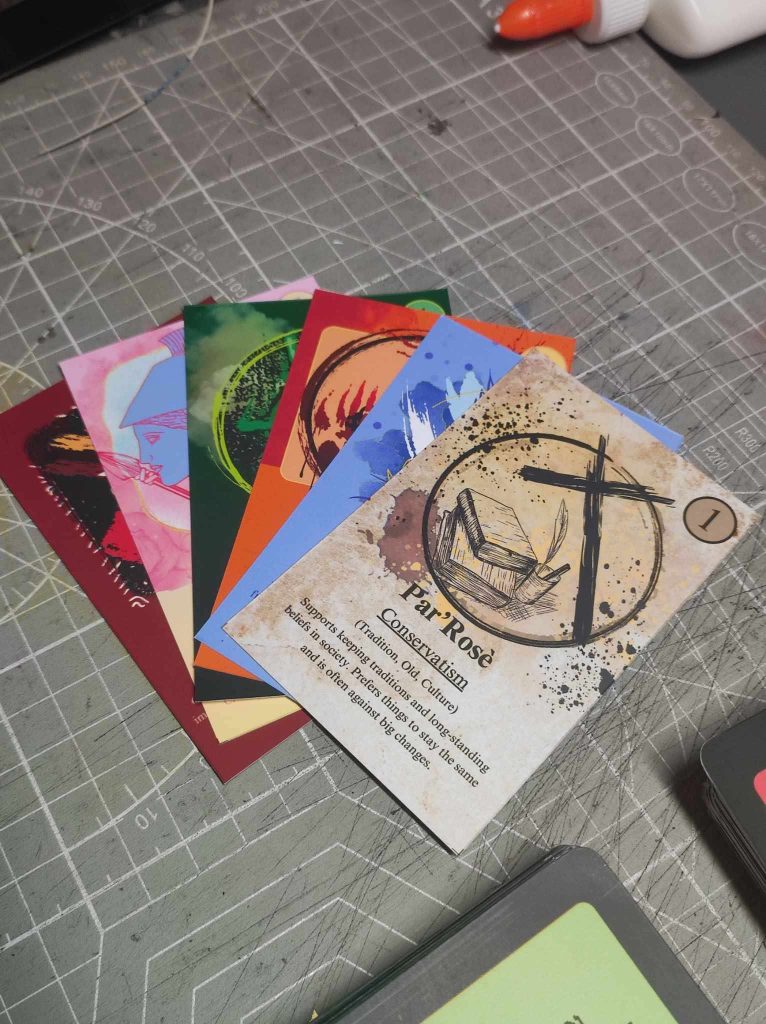
Ideology cards
Prior to the start of the game, each player will be given an Ideology card which they will represent. This card will be replaced per round.
click here to check the cards out
Scenario cards
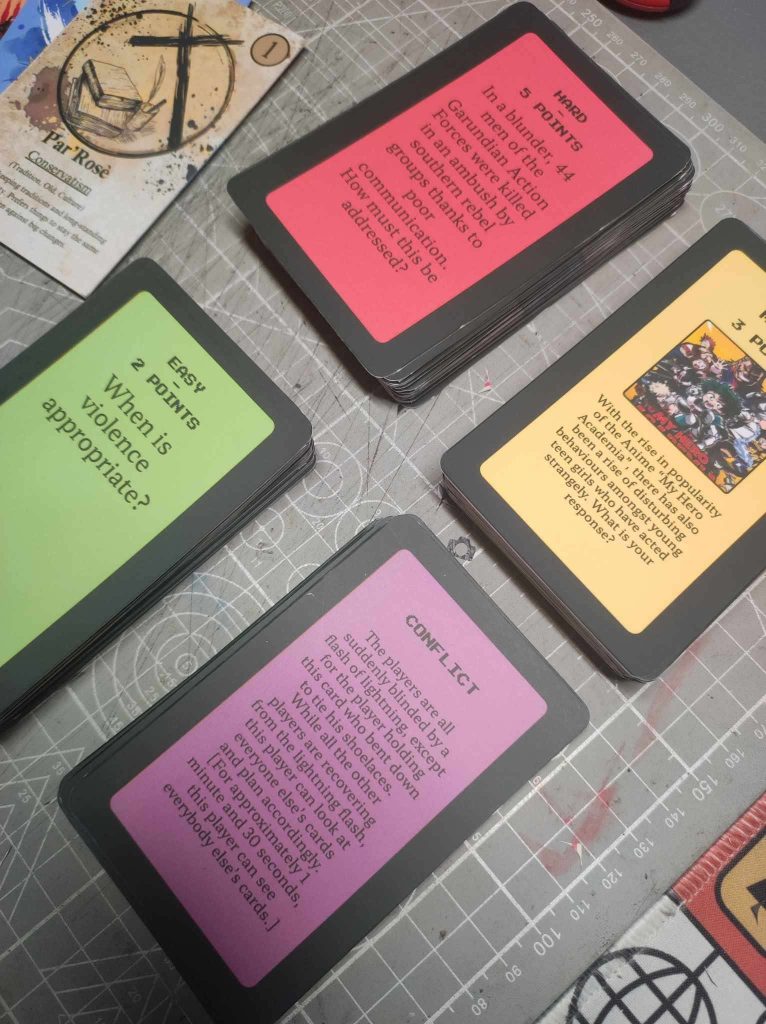
When players are ready they roll a dice to learn who will take a Scenario card first. These cards are the scenarios that the players need to take turns giving their view on. There are four variations of these scenario cards. They are: easy, medium, hard (text only), and hard (image only). Each have a certain amount of points designated to them. These cards give the points needed to win the game.
click here to view the cards as well as the conflict cards
Conflict Cards
These are cards that are shuffled in with the deck of scenario cards. They function like wildcards during the game, giving players certain advantages over others or just causing chaos within the game to keep players engaged.
The Peacekeeper
Someone will play the role of the peacekeeper, who will be selected among the players. Their role is to make sure that each player will state their answer in the allotted time. The peacekeeper is usually the most knowledgeable of political ideologies within the group. They act like a game master or a facilitator during the card game.
Game progression
Each player will be given 1 minute to answer, their response must be based on the given political ideology. The Peacekeeper will time each player all throughout the game.
At any given time, other players can use the center buzzers to counter-argue the person speaking. The timer would now reset to 1 minute. The Peacekeeper will also have to keep in mind the people buzzing. There are only three buzzers available for everyone in total per round.
Round ends with all players voting on who would get the scenario card, voting for oneself is not allowed. The number of rounds is 3-6 rounds, however players can exceed 6 rounds if willing. Winner of the game is decided through the one with the most points.
Feedback from Players
*Anonymous players’ feedback are sourced from post-test’s comments